
Paris Fashion Week, held from Monday, September 29th to Tuesday, October 7th, 2025, brought together around 100 brands and 70 runway shows, in an edition where the tension and excitement of a true generational transition could be felt. From new talents presenting for the first time to traditional houses showcasing their spring-summer 2026 collections, the event was marked by a series of significant shifts in creative teams, what many are already calling “the great game of musical chairs” in contemporary fashion.
DIOR

Jonathan Anderson’s first appearance at Dior was one of the most anticipated moments. After his departure from Loewe, the British designer assumed total control of the house, becoming the first creative director since Christian Dior himself to oversee all lines: womenswear, menswear, and haute couture. Anderson opted for an intellectual and visual exercise, revisiting the firm’s historical archives and opening the show with a short documentary directed by Adam Curtis, titled Do You Dare to Enter the House of Dior. His proposal sought to confront tradition with a critical look at the present, questioning whether fashion can still move and innovate. His challenge now will be to keep the Dior heritage alive while propelling it toward a new contemporary horizon.
BALENCIAGA

After Demna’s departure and the disconnect he had shown with the brand’s historical legacy, Balenciaga entrusted Pierpaolo Piccioli, former creative director of Valentino, to reconnect with the essence of the great Cristóbal Balenciaga. The show was a tribute to its roots: the space smelled of “Guetaria,” a fragrance inspired by the couturier’s hometown, while the wide silhouettes, architectural necklines, and voluminous skirts recalled his original language. The collection began with monochromatic styling and dominance of black and white, but gradually Piccioli’s touch imposed itself through the use of coral colours and vibrant tones. The result was an elegant and understated debut that restored Balenciaga’s sense of purity and form.
MUGLER

Unlike the big names before him, Miguel Freitas Castro was not a well-known figure on the international scene. Former creative director of Sportmax, this debut marked his true arrival at a renowned house. His challenge was enormous: to keep Thierry Mugler’s theatricality alive while contributing a new narrative. Under the title “Stardust Aphrodite,” Freitas presented a collection of powdery tones and monochromatic styling, with a predominance of pink and black. His vision of feminine seduction was based on duality: power and vulnerability, goddess and temptress. A solid and promising debut following Casey Cadwallader’s departure, which signals the beginning of a new era for Mugler.
CHANEL

Without a doubt, the most anticipated show of the season was Matthieu Blazy’s at Chanel, a debut that captured all eyes. Blazy becomes only the fourth creative director in the maison’s history, after Coco Chanel, Karl Lagerfeld, and Virginie Viard. His appointment represents not only a symbolic transition but also a new chapter for one of the world’s most iconic houses. Blazy, known for having transformed Bottega Veneta into one of the most respected and influential brands, recovered Coco Chanel’s foundational symbols—tweed, masculine suits reinterpreted in a feminine key, pearls, and floral motifs—to build a collection that evoked the house’s origins without falling into nostalgia. Blazy opted for loose waistlines, straight silhouettes, and lightweight fabrics that free the body, returning to the maison’s original purpose: giving women freedom through fashion. Orange, red, and golden tones added freshness to a solid debut that was both classic and modern.
CELINE

Two months after his appointment and with Hedi Slimane’s shadow still present, Michael Rider presented his first collection for Celine. His proposal achieved a balance between the legacy of Phoebe Philo—who had defined the brand’s contemporary and sophisticated spirit—and Slimane’s recent heritage. Rider proposed a cosmopolitan, practical, and refined woman, moving away from the rocker and androgynous aesthetic to return to a modern femininity in a preppy and functional key. It was a natural and convincing transition that steered the house’s identity back toward its essential elegance.
Gaultier

For the first time, Jean Paul Gaultier has a permanent creative director: Duran Latnik. His debut opted for a queer and raver aesthetic, experimental and deliberately uncomfortable. Although the approach was bold, the public’s response was lukewarm, indicating that the balance between Gaultier’s provocative DNA and Latnik’s vision has yet to be found. The future will tell whether this new direction manages to consolidate itself or remains a risky attempt without continuity.
MARGIELA
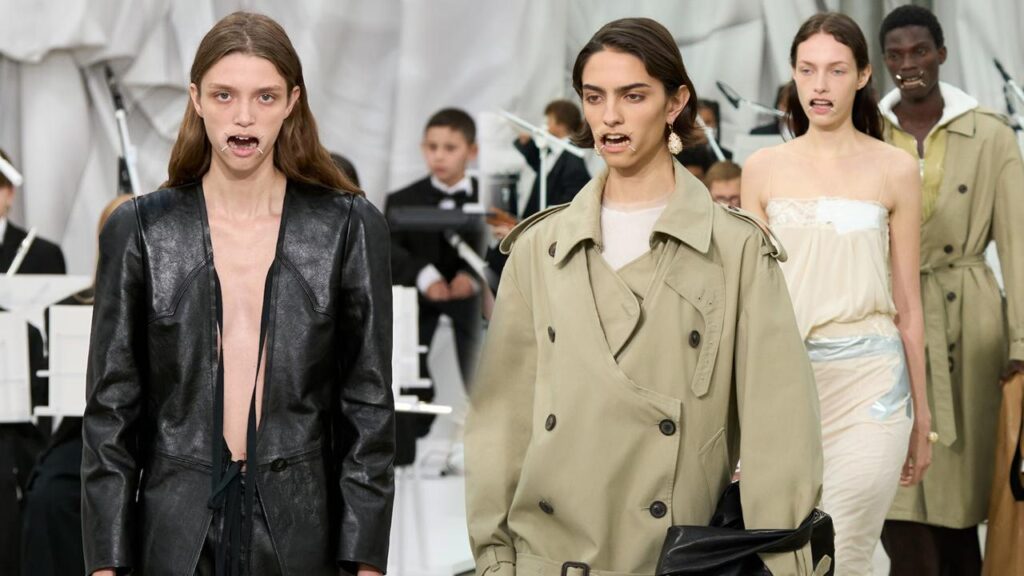
Glenn Martens’ debut in Maison Margiela’s prêt-à-porter line was another of the most anticipated, following the success of his first Artisanal collection. True to the founder’s legacy, Martens presented lingerie-inspired pieces, lace details, and worked necklines, combined with a conceptual approach that reaffirms his ability to reinterpret Margiela’s deconstruction without losing authenticity. It was a coherent, precise collection deeply faithful to the spirit of the maison.
Paris Fashion Week 2025 will be recorded as a turning point. An edition in which new names took command of the most emblematic houses, facing the weight of heritage with the need for renewal. If this season made anything clear, it’s that fashion is still alive, in constant reinvention, and that Paris continues to be its natural epicenter: the place where past and future intersect, always to the rhythm of change.


